

Documentation
Word Exporter for ConfluenceBrowse
Documentation
Word Exporter for ConfluenceScheduled Exports
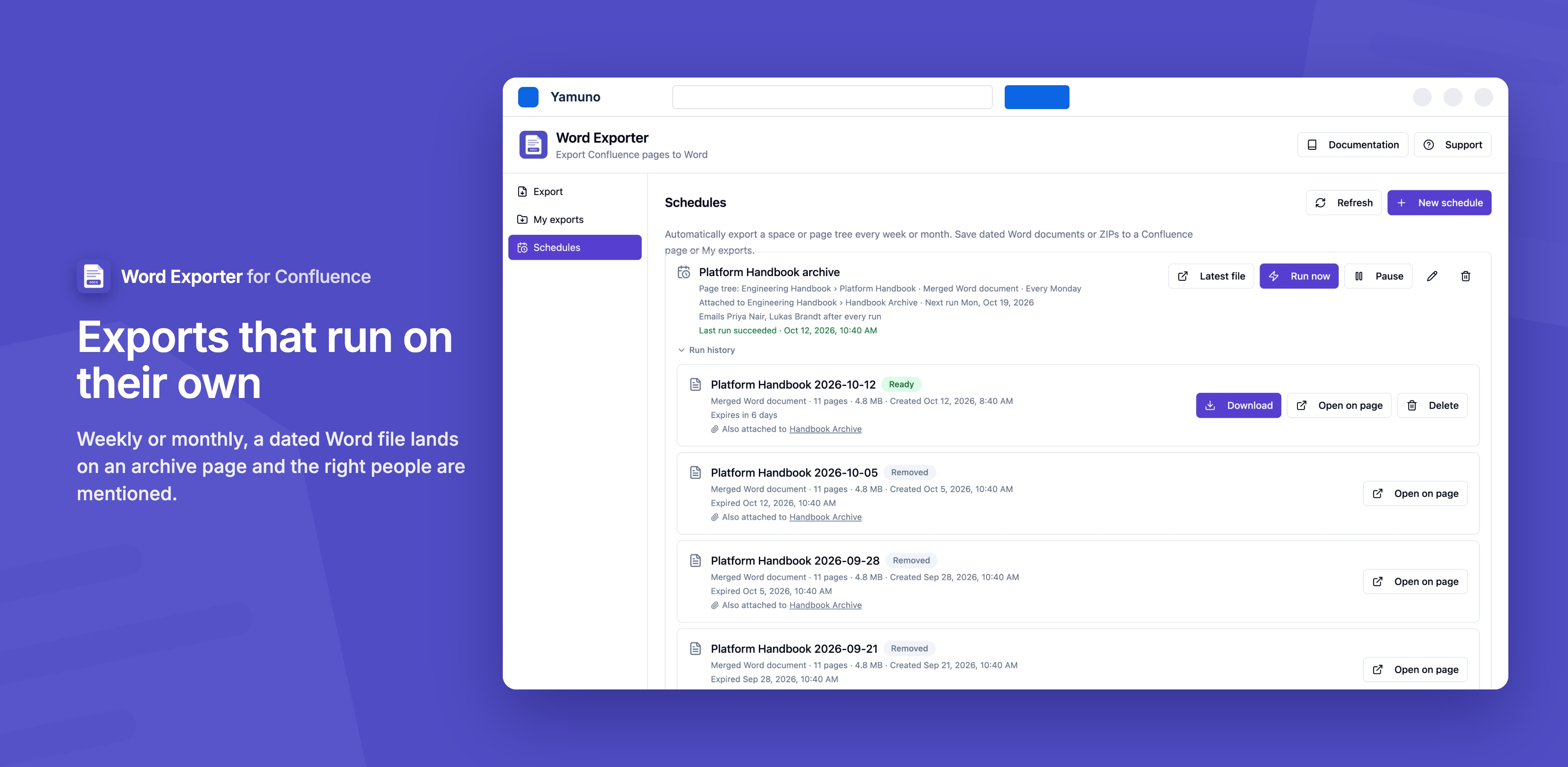
Keep regular snapshots without doing anything by hand. A schedule exports a whole space, or a page and everything under it, every week or every month. Each run saves a dated Word document (or ZIP) to an archive page in Confluence, or to your My exports, and can email people when it's done.
It's built for compliance and retention teams, space admins, and anyone who needs a monthly "as it was" copy of their documentation that they can still edit. Nothing leaves Atlassian.
Creating a Schedule
- Open Apps → Word Exporter for Confluence
- Select Schedules in the sidebar, then New schedule
- Fill in the form:
| Setting | What it does |
|---|---|
| Name | Used in the file names: Compliance snapshot 2026-11-01.docx |
| What to export | A page and its children, or A whole space |
| Style Template | Any saved template. Template edits apply to the next run. |
| Output | One merged Word document or ZIP of Word files |
| How often | Weekly on a weekday, or Monthly on a date from 1 to 28 |
| Where it goes | Attach to a page (an archive page you can edit), or Keep in My exports only |
| Notify by email | Every run, Only failures, or Off, and who to notify |
- Click Create schedule
The form shows when the first run is due.
When Schedules Run
Schedules run once on their day. Confluence picks the time of day, so a schedule says "every Monday", not "every Monday at 9:00". Dates are in UTC.
Run now on a schedule's card runs it straight away without changing its regular dates. It's useful for a first test.
What's exported is worked out again at every run, so pages added since the schedule was created are included.
Where the Files Go
Attach to a page: each run's file is attached to the archive page you chose, named with the run date, so the page's attachments list every run in order. These files stay until someone deletes them. You need permission to edit the archive page.
Keep in My exports only: each run's file appears in your My exports and is deleted after the retention period (7 days by default). Choose an archive page if you need to keep every run.
Either way, every run also shows in the schedule's Run history and in My exports.
Email Notifications
With Notify by email turned on, the app comments on the archive page after a run and @mentions the people you chose. Confluence then emails them, as it does for any mention. The comment links to the new file, or says why the run failed.
- Recipients must be able to view the archive page to be notified
- Notifications need an archive page, so they're not available with Keep in My exports only
- Each schedule posts one comment and adds every later run as a reply to it, so the page keeps a single thread. If the comment is deleted or the archive page changes, the next run starts a new thread
- Every run replies after each run; Only failures keeps the thread quiet unless something goes wrong
Permissions and Access
Every run uses the schedule owner's access, meaning the person who created it:
- Only pages the owner can view are exported. If the owner loses access to some pages, they're left out and the run says how many were skipped.
- The owner must still be able to edit the archive page.
- If the owner is deactivated or removed from the site, the schedule pauses.
Failures and Pausing
A failed run shows the reason on the schedule's card in plain words, for example "Archive page was deleted". Some problems pause the schedule straight away:
- The archive page was deleted, or the owner can no longer edit it
- The exported space or top page was deleted
- The owner is no longer active
Other failures pause the schedule after three failed runs in a row. Resume a paused schedule once the problem is fixed; it continues from its next regular date.
If the template was deleted, the default style is used and the run says so.
Managing Schedules
On each schedule's card:
- Run now, Pause / Resume, Edit and Delete
- Latest file: open the most recent file on the archive page
- Run history: the last runs, with their files and any notes
Deleting a schedule keeps the files it already produced.
Admins see every schedule on the site in Confluence Settings → Word Exporter → Schedules, with each one's owner, status and next run, and can pause, resume or delete any of them.
Stuck on something this page does not cover? Ask the developers.